
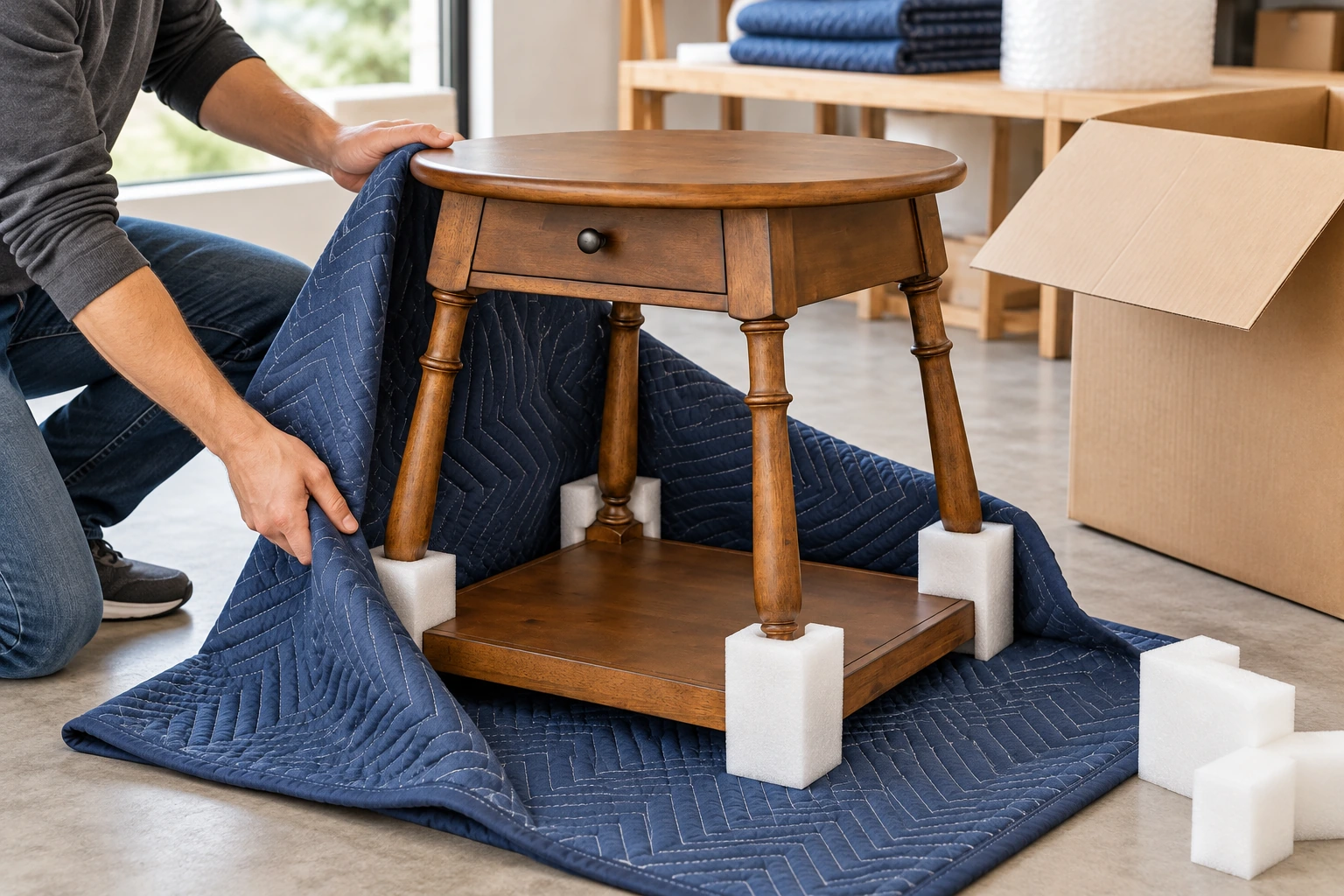
To pack furniture for shipping, clean it and record its condition. Remove detachable parts, protect surfaces and corners, and secure the load for the chosen service. Furniture packaging should prevent rubbing, movement, and pressure on vulnerable parts while allowing safe handling.
The steps cover parcel, LTL freight, and blanket-wrap shipments, plus wood-packaging and moisture precautions for international transport.
Confirm the Shipping Method and Carrier Requirements
Choose a service using packed dimensions and gross weight, including all packaging. Compare packing and freight charges together. Parcel carriers commonly charge for whichever is greater: the package’s actual weight or its dimensional weight.
Dimensional weight (lb) = length × width × height (inches) ÷ carrier divisor
UPS publishes divisors of 139 for Daily Rates and 166 for Retail Rates. Follow its measurement and rounding rules. Removing detachable legs reduces empty package space. If length and width stay the same, reducing packed height from 30 to 6 inches cuts volume by 80%. Actual weight and minimum charges can limit savings.
Small Parcel Shipping
Parcel shipping works for furniture that fits the selected service’s limits once packed. For U.S. FedEx Ground, those limits are 150 pounds (about 68 kg), 108 inches in length, and 165 inches for length plus girth. Girth equals twice the width plus twice the height. A piece weighing less than 150 pounds may still need freight if its package exceeds the size limits.
LTL Freight·
LTL, or less-than-truckload, service carries furniture alongside other shippers’ freight. Transfers and forklift handling can cause impacts; nearby loads can cause compression. Confirm the carrier’s base, crate, and stacking requirements before packing. A 48-by-40-inch pallet suits many loads, but larger pieces need a base that supports their full footprint.
Blanket-Wrap Shipping
Specialist blanket-wrap carriers handle assembled furniture, including some antiques they accept. Padded blankets protect surfaces, and vehicle restraints hold the furniture in place. Ask about transfers and handling arrangements. Glass, mirrors, and stone components may still need rigid crates.
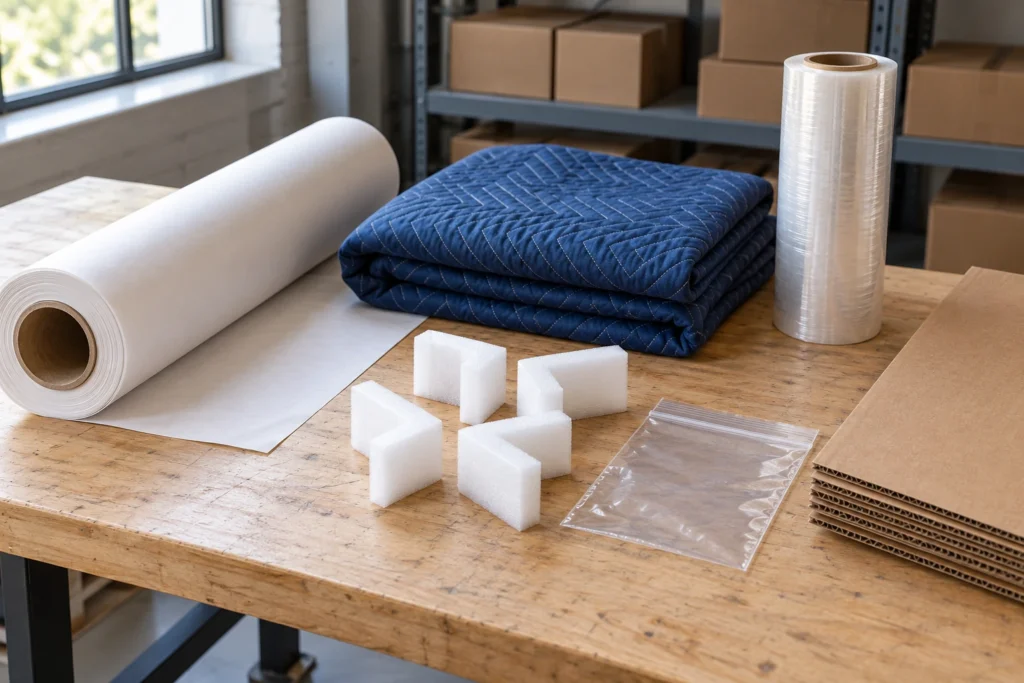
Furniture Packing Supplies Checklist
Protect the finish with a contact layer, then add cushioning and an outer package or restraints.
Surface Protection and Cushioning
Place clean, unprinted, acid-free paper or foam compatible with the finish against exposed surfaces. Add thick moving blankets and padded edge guards. Avoid newspaper, whose ink can transfer. Keep tape off finishes and stretch film over protective layers. Wood and leather must be dry before airtight wrapping.
Boxes and Securing Materials
For heavy boxed components, start with new double-wall cartons and check the manufacturer’s gross-weight limit. A “275-lb burst” marking describes a board test; it does not mean the box can carry 275 pounds. ECT, or edge crush test, measures resistance to edge compression. Choose fitted crates for fragile pieces that need rigid support. Have dense foam blocks, corner boards, stretch film, and load-rated banding ready.
Hardware Bags and Labels
Use labeled resealable bags for screws, washers, and fittings. Pad and secure them inside the package so metal cannot hit finished surfaces. Prepare component tags, shipping labels, and a packing list.
How to Pack Furniture for Shipping in 6 Steps
Prepare the furniture before choosing its final outer package. Use boxes, crates, or pallets as the booked service requires, following the material-specific precautions below.
Step 1: Inspect, Clean, and Photograph the Furniture
Empty drawers and cabinets, then remove dust and grit using a cleaning method suitable for the finish. Particles left beneath the wrapping can scratch surfaces as the load vibrates. Vacuum upholstery and allow cleaned areas to dry. Photograph every side, including joints, corners, and existing damage. Record dimensions, weight, and item identifiers before taking anything apart.
Step 2: Disassemble Removable Parts When Appropriate
Follow the assembly instructions when removing detachable legs, shelves, bed rails, or protruding handles. Leave glued joints and antique joinery intact unless a qualified specialist advises otherwise. Label matching components and bag their hardware together. Secure attached drawers and doors with padded restraints to prevent movement and strain on their hinges during transit.
Step 3: Wrap Surfaces and Protect Corners
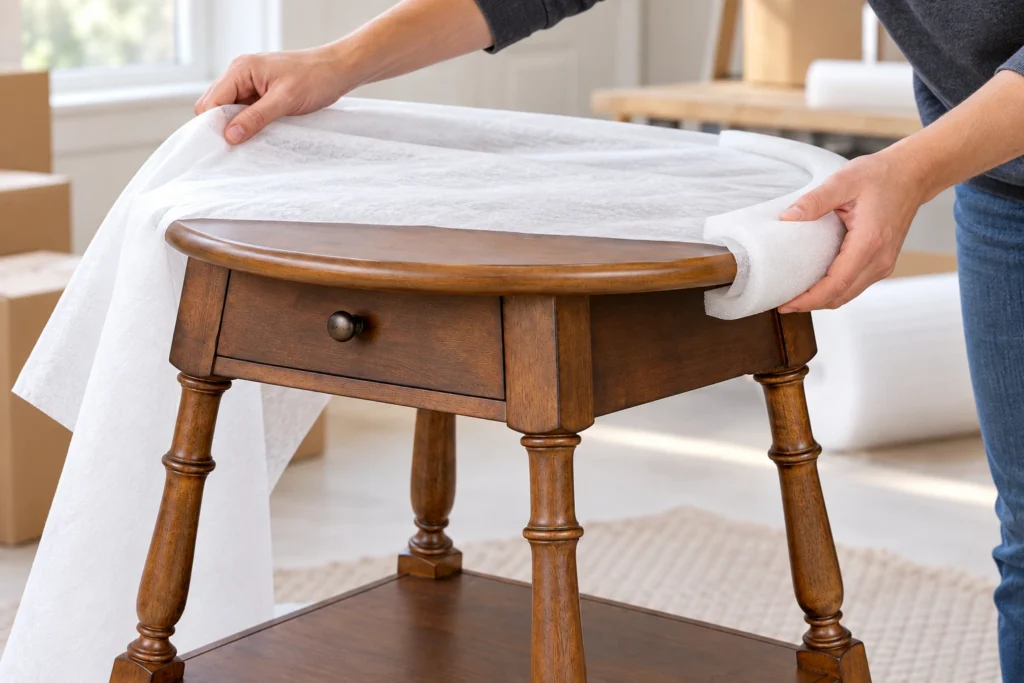
Cover the finish, add cushioning, and fit padded corner guards. On an end table, protect the top edges as well as the legs and base. Apply stretch film from the bottom upward. When wrapping by hand, overlap each pass by about half the film width for continuous coverage. Use enough tension to hold the layers without crushing upholstery or bending panels.
Step 4: Pack the Furniture for Its Shipping Method
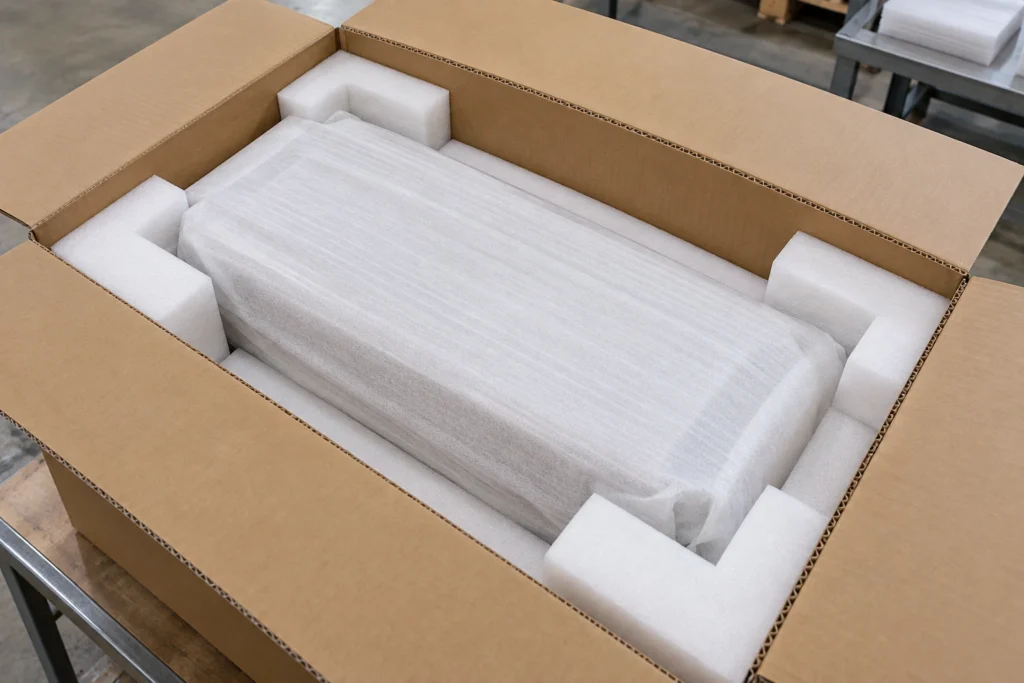
Leave room for cushioning on every side of a boxed piece. FedEx recommends measuring the wrapped item and adding 3 to 5 inches (7.6 to 12.7 cm) to each overall dimension. The increase applies to each total dimension, not to each side. Center the item on cushioning and block the gaps with material firm enough to support its weight. It should stay in place during gentle handling.
Seal the top and bottom with packing tape at least 2 inches wide. Cover the center seam and both edge seams to form an H. Inside a crate, brace structural parts and support broad panels. For blanket-wrap service, follow the agreed padding arrangement.
For repeat commercial shipments, a lab can test the complete package using ISTA 3A for parcel distribution or 3B for LTL. Both simulate transport shocks and vibration to reveal packaging weaknesses.
Step 5: Secure the Shipment to a Pallet If Required
Keep the whole package within the pallet edges, with heavy units low in the load. Stack cartons with their corners aligned vertically and maintain a level top wherever stacking is permitted. Place corner protectors beneath the bands and anchor the load to the pallet. Strapping cartons together alone does not secure them to the base. Wrap the load and pallet base together, keep fork openings clear, and retain the specified banding.
Step 6: Check Shipment Details and Prepare for Pickup
Measure the final outside dimensions and gross weight. Number packages, such as “1 of 5,” and list their contents, component IDs, dimensions, and weights.
Match the information to the freight bill of lading, which records the shipment and transport agreement. Add orientation and stacking labels where appropriate; handling labels cannot replace protective packaging. Photograph the closed load and confirm the pickup equipment. For repeat orders, put the approved packing requirements in the furniture OEM brief.
Packing Tips for Different Types of Furniture
A dining collection may combine wooden tops, upholstered seating, and cabinets that need different protection.
| Furniture Type | Packing Method | Key Precaution |
| Solid-wood tables and antique cabinets | Use a finish-safe liner, blankets, padded corners, and continuous support beneath broad tops. | Avoid unsupported spans and pressure on joints or projecting handles. |
| Leather and upholstered sofas | Use a clean, breathable inner cover, padding, and outer protection accepted by the carrier. | Keep dry and prevent straps or stacked objects from compressing the upholstery. |
| Glass, mirrors, and marble tops | Use padded edge supports and a fitted upright crate or A-frame rack. | Secure panels against flexing, tipping, and contact with one another. |
| Knock-down furniture panels | Separate faces with soft sheets, align the panels, and block movement inside a heavy-duty flat carton. | Protect drilled holes and corners, and prevent panels from sliding against each other. |
| Mattresses | Use a fitted protective bag and a rigid mattress carton with suitable support. | Fold or compress the mattress only when its manufacturer permits it. |
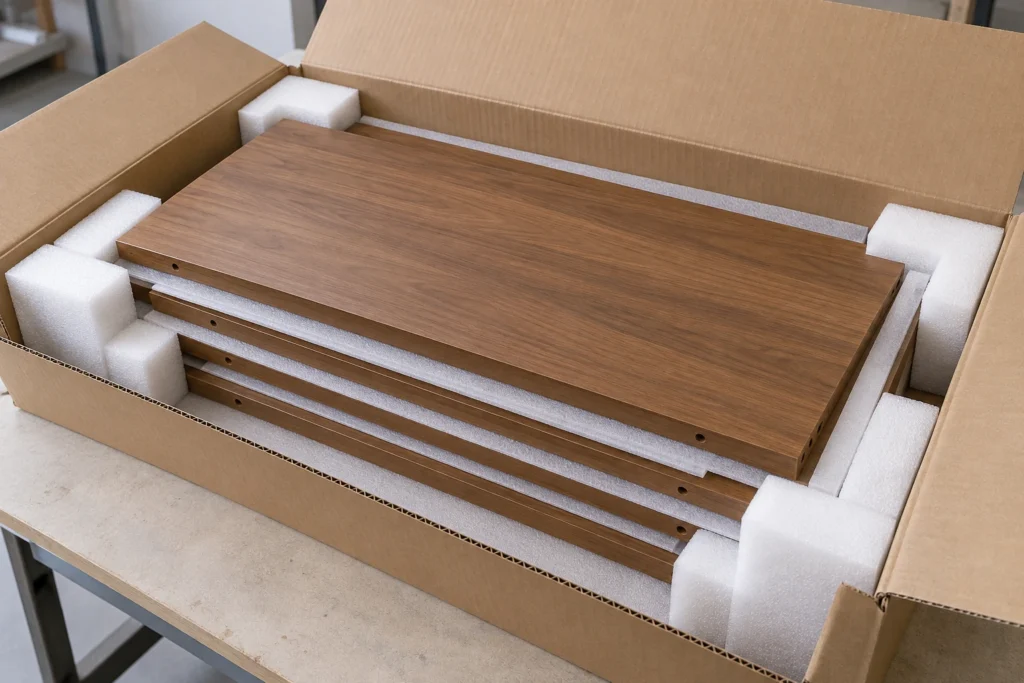
Knock-down furniture is designed to ship in parts for assembly at its destination.
Packing Furniture for International Shipping
Arrange wood treatment and moisture protection before closing the crates. For ocean freight quotes, calculate CBM, or cubic meters, by multiplying the final package’s length, width, and height in meters. Include the packaging in the volume the forwarder assesses.
Check ISPM 15 Requirements for Solid Wood Packaging
ISPM 15 controls pest risks in raw-wood packaging. Regulated pallets, crates, and bracing made from raw wood thicker than 6 mm need approved treatment and the official International Plant Protection Convention mark.
Conventional heat treatment requires at least 56°C throughout the wood, including its core, for 30 continuous minutes. Buy marked packaging from an authorized supplier. Packaging made entirely from processed wood, such as plywood, is exempt. Solid-wood runners or braces within a plywood crate can still require compliance.
Prevent Moisture and Container Rain
Check that the container is dry and weather-tight before loading dry furniture, packaging, and bracing. Heat-treated timber can still hold moisture. Container rain occurs when moisture in humid air condenses on colder container walls or the roof, then drips onto the cargo.
Use breathable contact layers and protect sensitive cargo from overhead drips. A sealed moisture-barrier package needs dry contents and desiccants, or moisture absorbers, sized for the enclosed moisture load and voyage. Loose stretch film cannot control humidity on its own. Container desiccants help protect a dry load, but they cannot reliably dry wet furniture or timber.
For a manufacturing order, discuss packing requirements with LEHOME. Send product references, dimensions, quantities, destination, and shipping method so the team can review shipment preparation and quotation conditions.
Inspect Furniture at Delivery and Report Damage
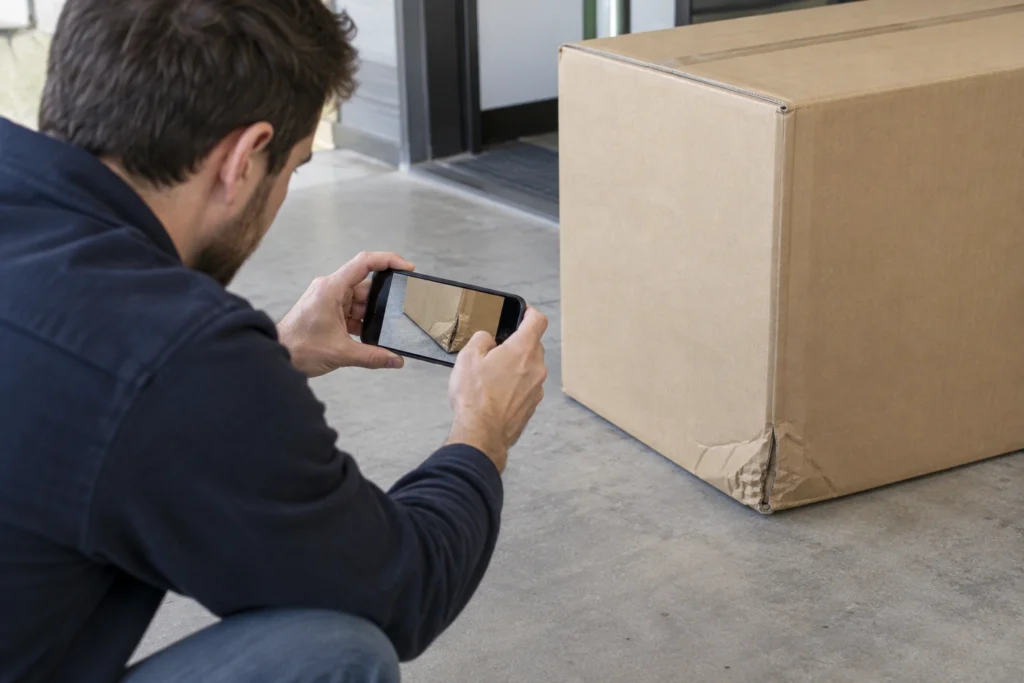
Before signing, inspect the packaging you can access. Describe visible damage in specific terms on the delivery receipt, photograph affected areas and labels, and keep the packaging and goods. Record any activated shock or tilt indicators. These show handling exposure, but they do not automatically establish who is responsible for damage.
Report concealed damage promptly through the carrier’s process. Keep invoices, packing records, and photographs. A clean receipt does not necessarily end a claim, and writing “subject to inspection” alone does not document actual damage.
Frequently Asked Questions
Can the Shipping Company Pack My Furniture?
Yes, some specialist carriers offer furniture packing through a separate agreement. Ask whether the quote includes materials, disassembly, and crating. With a transport-only booking, the shipper usually needs to provide a package the carrier accepts, ready for collection.
Do I Need a Liftgate for Furniture Pickup?
Arrange a liftgate for palletized furniture when no loading dock or suitable forklift is available. The powered platform raises freight to truck height. Give the carrier the package dimensions and gross weight so it can confirm capacity and safe access.
Do I Need Additional Coverage for Furniture Shipping?
Consider additional coverage when the carrier’s liability leaves much of the furniture’s value unprotected. Compare payout limits, deductibles, and packaging exclusions. For FedEx shipments, increasing declared value raises the liability limit without purchasing cargo insurance.